
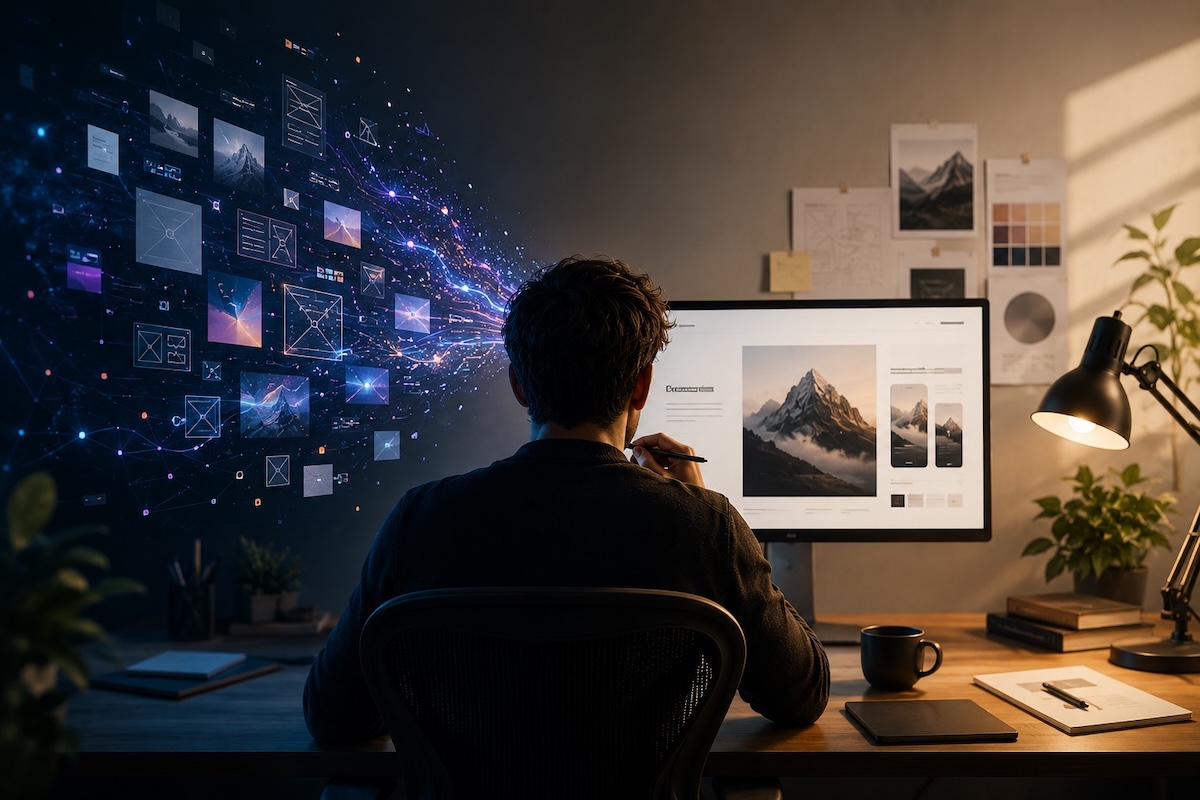
AI has changed digital design quickly. It can generate layouts, images, interface ideas, headlines, colour palettes and campaign concepts in moments. Used well, it can speed up exploration, reduce repetitive work and open up creative directions that might otherwise take hours to test.
That is not a small thing. AI is a powerful tool. But a tool is not the same as a designer.
The real question is not whether AI can produce design work. It clearly can. The better question is whether it can understand what the work is for, who it must serve, and what will make it succeed. That is where designers still matter.
AI makes design faster, but not automatically better
AI can produce a lot of options very quickly. For designers, this can be enormously useful. It can help with early exploration, moodboarding, idea generation, content variations, wireframe prompts and visual directions.
But more options do not always mean better decisions.
Digital design is not simply about producing screens. It is about making choices. What should be shown first? What should be removed? Where will users hesitate? What will build trust? What will make the next step obvious?
AI can accelerate the making. A designer gives the making a purpose.
Good design begins with the right questions
Many digital projects go wrong before anyone opens a design tool. The problem is poorly framed. The audience is vague. The message is unclear. The business goal is assumed rather than understood.
A designer brings the discipline of asking better questions:
- Who is this for?
- What are they trying to do?
- What might confuse them?
- What needs to feel simple?
- What must the user trust before they act?
- What does the business need this page, product or campaign to achieve?
These questions are not decoration. They are the foundations. AI can help answer a brief. A designer helps shape the brief.
The value is in judgement
One of the most important skills in modern design is knowing what to keep and what to reject.
AI can generate ten possible layouts, but not every polished option is a good option. Some will look impressive while weakening the message. Some will follow a trend but feel wrong for the brand. Some will be visually rich but harder to use.
A designer brings judgement. They can see when the hierarchy is weak, when the journey is unclear, when a call to action lacks confidence, when a colour choice undermines trust, or when an interface is asking too much of the user.
This is not anti-AI. It is how AI becomes useful. The designer becomes the director, editor and decision-maker.
AI is excellent at exploration
One of the best uses of AI is at the beginning of the process. It can help a designer look sideways. It can suggest unexpected combinations, generate alternative routes, produce quick variations and challenge the first obvious idea. It can be a sketchpad, a research assistant, a brainstorming partner and a production accelerator.
That can make the creative process richer. But exploration is not the same as resolution.
At some point, the work has to become specific. It has to serve one audience, one brand, one journey, one outcome. It has to stop being a cloud of possibilities and become a clear experience. That is where the designer earns their place.
Digital design needs context
A website, app or campaign does not exist in isolation. It sits inside a business. It speaks to a particular audience. It has to work across devices, channels, behaviours and expectations. It has to support trust, usability, accessibility, conversion and brand recognition.
AI can recognise patterns, but context is harder. The same design choice can be right in one situation and wrong in another. A bold visual style might work for a lifestyle brand but damage credibility for a professional service. A playful tone might help one audience and unsettle another. A highly creative layout might impress internally but frustrate real users.
A designer understands that good design is not merely attractive. It is appropriate.
Consistency is still hard
AI can create strong individual outputs. A striking visual. A useful concept. A clean mock-up. A set of promising directions.
But brands are not built from isolated moments. They live across websites, social channels, email campaigns, landing pages, adverts, videos, product interfaces, sales decks and customer journeys. The challenge is keeping all of this coherent.
This is where designers remain essential. They create systems. They manage typography, spacing, colour, imagery, components, tone and behaviour. They make sure the brand does not drift from one asset to the next.
AI can help produce parts of the system. A designer protects the whole.
Taste and restraint matter more than ever
AI gives us abundance. More options. More variations. More styles. More content. More ways to fill the screen.
But digital users rarely need more. They usually need clearer.
A designer knows when to simplify. They know when a layout needs space, when a message needs to be shorter, when an image is decorative rather than useful, and when the clever idea is getting in the way of the obvious one.
Taste is not about being fashionable. It is the ability to recognise what feels intentional, suitable and clear. In a world where almost anyone can generate something visually acceptable, restraint becomes a serious advantage.
The future is designer plus AI
The strongest future is not designer versus AI. It is designer plus AI.
Designers who use AI well will be able to explore faster, test more directions, automate repetitive tasks and produce richer creative work. They will not be replaced by the tool. They will be extended by it.
But the value still sits in the human part of the process: the judgement, the taste, the empathy, the understanding of context, and the ability to turn a messy business problem into a clear digital experience.
AI can help make the work. A designer makes the work matter.
Why businesses still need designers
Businesses do not need more digital noise. They need clarity.
They need websites that are easy to use. Interfaces that make sense. Campaigns that feel consistent. Brands that are trusted. Content that guides people rather than overwhelms them. Digital experiences that help users act with confidence.
AI can contribute powerfully to all of this, but it still needs direction. A good designer brings that direction.
They know how to use the tool without being ruled by it. They know when to explore and when to decide. They know how to combine speed with thought, creativity with structure, and visual polish with commercial purpose.
AI has changed design. But it has not removed the need for designers. It has made the best ones even more valuable.